

128 Renovation and Construction Statistics for Portugal (October 2026)
Anyone planning building work on a home in Portugal can draw on more public data than ever, but it is scattered across reports from INE (the national statistics office), Eurostat spreadsheets, ADENE open-data files and Banco de Portugal notes, most of it only in Portuguese. This page brings it together in English, with every number linked to the original document that published it.
The overall picture is clear: Portugal’s homes are younger than the European average but poorly maintained, building and repairing costs more every month, skilled labour is the most contested resource in the sector, and EU efficiency targets will require millions of homes to be renovated by 2050. For an owner, that means putting off work rarely makes it cheaper.
We have organised the data into eight themes, from building permits to the future of EU regulation, with a focus on the Porto, Braga and Aveiro regions, where BluePeak works. The page is updated every month as sources publish new data. Last updated: October 2026.
Key Takeaways
- Confidence among construction firms in Portugal reached +6.3 in August 2026, the highest level since March 1989 (European Commission, Sep 2026)
- 7,400 dwellings in new family housing were completed in Q2 2026, 11.6% more than a year earlier (INE, Sep 2026)
- In 2021 there were 723,215 vacant dwellings in Portugal, 12.1% of the entire housing stock (INE, May 2024)
- In 2023, 6.0% of the population in Portugal lived in severe housing deprivation, above the EU’s 4.0% (Eurostat, May 2026)
- Producer prices for electrical wires, cables and wiring devices rose 25.0% in Portugal in August 2026, against 9.6% in the EU (Eurostat, Oct 2026)
- At consumer level, materials for the maintenance and repair of the dwelling became 3.2% more expensive in Portugal in August 2026, double the EU’s 1.6% (Eurostat, Oct 2026)
- The median bank valuation of housing rose 177% in ten years, between August 2016 and August 2026 (INE, Sep 2026)
- Since 2015, the house price-to-income ratio has risen 82% in Portugal, against 12.8% across the OECD on average (OECD, Oct 2026)
- 97.7% of the 9,933 completed new homes that received an energy certificate between July and September 2026 were rated A or A+ (our calculation from the SCE open data) (ADENE, Oct 2026)
- 26.9% of people aged 65 or over living alone in Portugal could not keep their home adequately warm in 2025, against 11.4% in the EU-27 (Eurostat, Sep 2026)
- The average monthly instalment on the stock of housing loans rose for the 12th month in a row to €446 in August 2026, the highest in the series (Banco de Portugal, Aug 2026)
- A bricklayer earned €1,252.1 a month on average in April 2026, up 7.2% on a year earlier (DGCP/MTSSS, Apr 2026)
- Even in public works, 77% of builders name the shortage of skilled labour as their main constraint (AICCOPN, Jan 2026)
- 85% of EU buildings were built before 2000 and 75% have poor energy performance, with an annual energy renovation rate of just 1% (European Commission, Sep 2026)
Building permits and completed works
Portugal is building against the European tide, and permit numbers tell only half the renovation story. Permits for renovation are falling, but firms in the segment still have months of work in their order books, because many jobs on existing homes never go through the town hall’s prior approval at all.
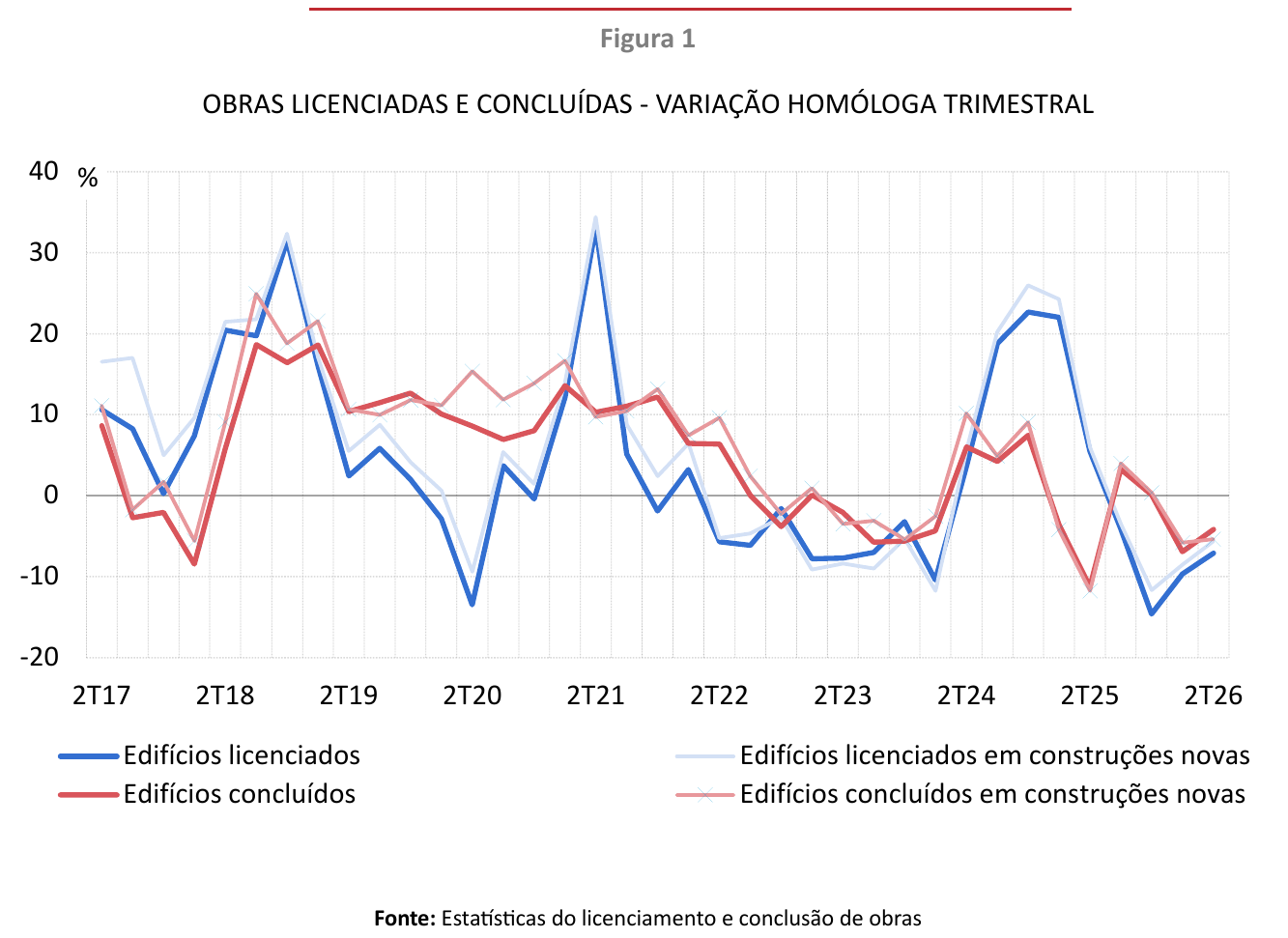 Figure 1: After the 2024 peak, building permits and completions slipped back into negative territory, but the fall eased in Q2 2026. Source: INE, Construção: Obras Licenciadas e Concluídas, 2.º trimestre de 2026 (Construction: Works Permitted and Completed, Q2 2026), Sep 2026. Chart published by the source (in Portuguese), captured 7 Oct 2026.
How many building permits are issued in Portugal, and how much is renovation?
Housing permits (licenciamento) are at a 15-year high, but in 2026 the number of buildings permitted is falling, with renovation dropping faster than new build.
- In 2025, 48,844 dwellings were permitted in Portugal, 14.6% more than in 2024 and the highest figure since 2011, yet only 30,425 dwellings were completed in the same year, according to INE, Portugal’s national statistics office (INE, Jul 2026).
- In Q2 2026, 6,200 buildings were permitted, 7.1% fewer than a year earlier: new construction fell 5.6% and renovation works dropped 11.9% (INE, Sep 2026).
- The index of dwellings permitted in residential buildings stood at 165.9 in Portugal in Q2 2026 (2021 = 100, seasonally adjusted), against 89.6 for the EU average (Eurostat, Oct 2026).
- Useful floor area permitted in residential buildings grew 11.9% in Portugal in Q2 2026, below the EU’s 13.3% (Eurostat, Oct 2026).
- In August 2026, urban renovation firms surveyed by AICCOPN, the Portuguese construction industry association, had an average of 9.4 months of contracted work, down from 10.8 months in August 2025 (AICCOPN, Sep 2026).
- In August 2026, activity in urban renovation fell 0.5% year on year, but the order book grew 2.9% (AICCOPN, Sep 2026).
Is construction growing faster in Portugal than in the rest of Europe?
Yes. Portuguese output is growing while European output shrinks, and Portuguese firms are far more optimistic than their EU peers.
- In July 2026, construction output grew 1.9% in Portugal compared with July 2025, while in the EU it fell 1.8% (calendar-adjusted data) (Eurostat, Oct 2026).
- In specialised construction activities, which include installations, finishing and roofing, output rose 5.1% in July 2026, against a 0.4% fall in the construction of buildings (Eurostat, Oct 2026).
- In 2025, the construction production index stood at 113.0 in Portugal (2021 = 100), against 105.1 in the EU (Eurostat, Oct 2026).
- The construction confidence indicator stood at +2.8 in Portugal in September 2026, against -6.1 in the EU (European Commission, Sep 2026).
- The balance of replies on order books was -3.7 in Portugal in September 2026, against -17.5 in the EU (European Commission, Sep 2026).
- On activity over the previous three months, the balance for Portuguese firms was +8.3 in September 2026, against -2.5 in the EU (European Commission, Sep 2026).
How are building permits changing in Porto, Braga and Aveiro?
The Norte region issues more permits than any other in the country, and the Porto, Braga and Aveiro sub-regions all permitted more dwellings in 2025 than in 2024.
- In Q2 2026, the Norte region accounted for 39.8% of buildings permitted, 35.1% of buildings for renovation and 47.8% of dwellings in new family housing, and was one of only two regions with more buildings permitted than a year earlier (+0.2%) (INE, Sep 2026).
- In 2025, the Área Metropolitana do Porto (Porto metro area) permitted 10,812 dwellings (10,103 in 2024), Cávado (Braga sub-region) 3,174 (2,339) and Região de Aveiro (Aveiro region) 1,682 (1,361) (INE, Jul 2026).
Ageing housing stock
The problem with Portuguese homes is not so much their age as deferred maintenance. The stock is actually younger than the European average, but the share of people living with leaks and damp is almost double the European rate, and every roof letting in water today is tomorrow’s medium-scale repair.
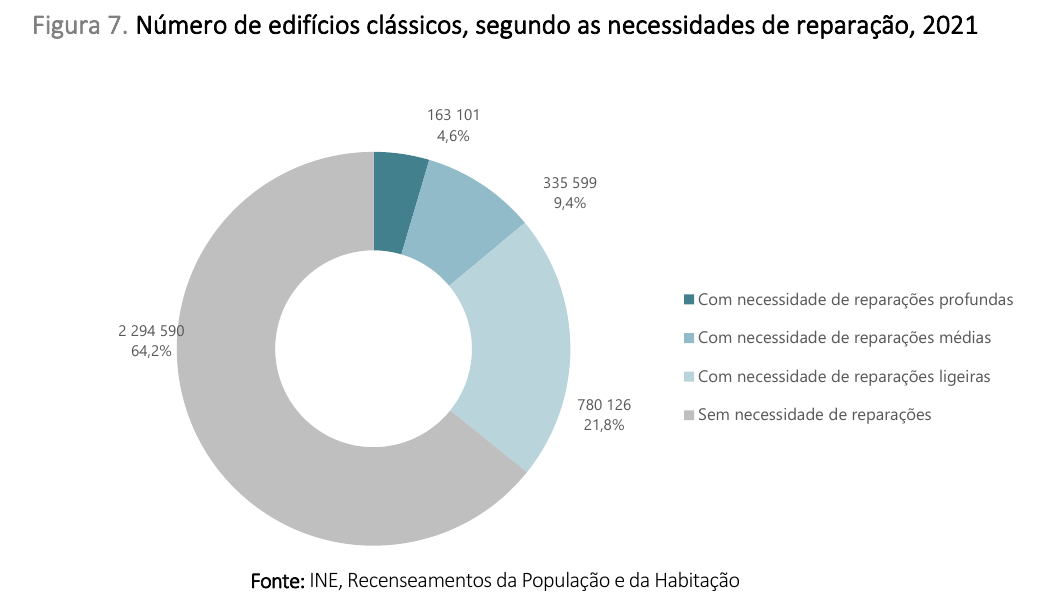 Figure 2: More than a third of the country’s buildings needed work in 2021, and almost half a million already required medium or major repairs, the kind of work that stops being optional. Source: INE, O Parque Habitacional: Análise e Evolução 2011-2021 (The Housing Stock: Analysis and Trends 2011-2021), Figure 7, May 2024. Chart published by the source (in Portuguese), captured 7 Oct 2026.
How many homes in Portugal need repairs?
More than a third. In the 2021 Census, 35.8% of buildings needed repairs: 21.8% minor (780,126 buildings), 9.4% medium (335,599) and 4.6% major (163,101), according to INE, Portugal’s national statistics office (INE, May 2024).
- In the last national survey, municipalities identified 14,748 buildings and 31,526 dwellings without minimum habitability conditions, home to 25,762 households, according to IHRU, the national housing institute (IHRU, Feb 2018).
- 97.0% of conventional buildings have no lift, and every six-storey building without a lift was built up to 1960 (INE, May 2024).
- In 2025, 34.5% of the population lived in an under-occupied home, with more rooms than the household needs, above the EU’s 33.4% (Eurostat, Sep 2026).
How many people in Portugal live with leaks and damp at home?
Almost three in ten. In 2023, 29.0% of the population lived in a home with a leaking roof, damp walls, floors or foundations, or rotten window frames, against 15.6% in the EU, the second-highest rate of the 27, behind only Cyprus (Eurostat, Aug 2026).
- The problem has got worse: the same rate was 24.4% in 2019 (Eurostat, Aug 2026).
- Among people below the poverty line, 38.4% live with leaks or damp, against 27.0% of those above it (Eurostat, Aug 2026).
- A third of children and young people aged up to 17 (33.0%) are growing up in a home with these problems (Eurostat, Aug 2026).
- In 2023, 8.1% of people in Portugal considered their home too dark, above the EU’s 6.7% (Eurostat, Aug 2026).
- Overcrowding, by contrast, is lower than in Europe: 12.7% of the population in 2025, against 16.8% in the EU (Eurostat, Sep 2026).
How old are the homes in Porto, Braga and Aveiro?
Cávado (Braga sub-region) has the youngest housing stock in the country, while in Greater Porto older buildings weigh more than the national average because little was built in the last decade. For every 100 buildings built after 2011 there were 747 built up to 1960 in Portugal, 826 in the Área Metropolitana do Porto (Porto metro area), 659 in Região de Aveiro (Aveiro region) and only 266 in Cávado (INE, May 2024).
- According to our calculation from 2021 Census data, dwellings built before 1981 make up 40.2% of the total in the Porto metro area, 41.2% in the Aveiro region and 31.1% in Cávado (Eurostat, May 2025).
- The stock renews slowly: according to our calculation from the 2021 Census, only 2.8% of Portuguese dwellings were built from 2011 onwards, against 6.5% in the EU, although the pre-1981 share is smaller, 45.0% against 59.9% (Eurostat, May 2025).
- Almost half of buildings (49.8%) were built after 1980, most of them between 1981 and 2000 (INE, May 2024).
If your home has leaks, damp or failing window frames, see how we handle a full house renovation or a roof repair, with real projects in our portfolio.
Construction costs
A building quote in 2026 mostly pays for the time of the people doing the work: labour costs have been rising faster than materials for more than three years, and this year materials have picked up again. INE’s official index measures the cost of building new homes, not renovation, but the prices of home repair services tell the same story.
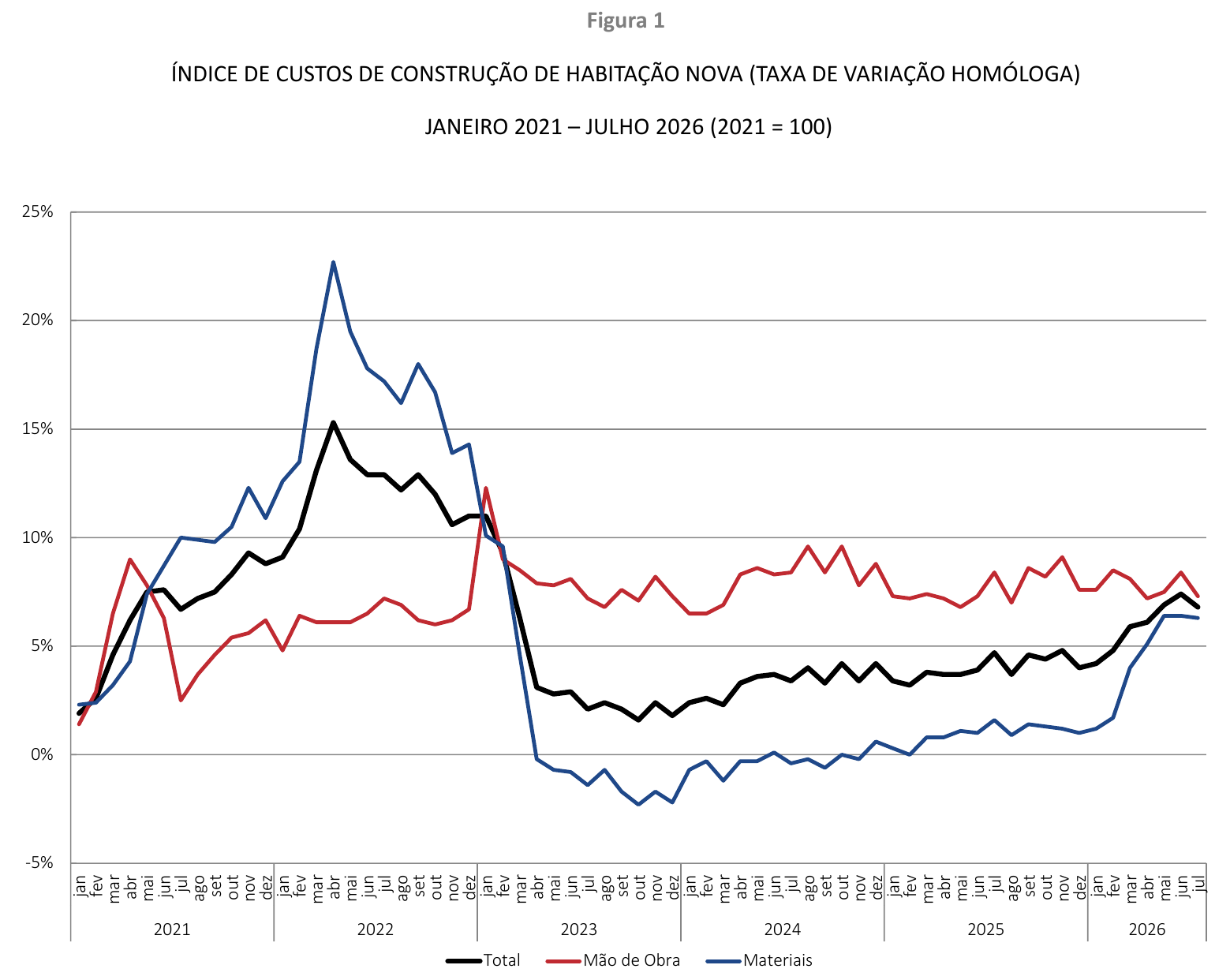 Figure 3: Labour has grown faster than the overall index since March 2023, and in 2026 materials left behind almost three years of changes close to zero. Source: INE, Índice de Custos de Construção de Habitação Nova, julho de 2026 (Construction Cost Index for New Housing, July 2026), Sep 2026. Chart published by the source (in Portuguese), captured 7 Oct 2026.
How much has the cost of building a house in Portugal gone up?
Far more than the European average, and the pace picked up in 2026. The latest figures are for July: INE, Portugal’s national statistics office, publishes the August index on 9 October 2026.
- In July 2026, the cost of building new housing rose 6.8% year on year, with materials up 6.3% and labour up 7.3% (INE, Sep 2026).
- The construction cost index for new housing reached 134.55 in July 2026 (2021 = 100): 144.8 for labour and 126.55 for materials (INE, Sep 2026).
- In Q2 2026, the construction price index for new residential buildings rose 6.8% in Portugal, the fourth-largest increase among the 25 member states with data, after Croatia, Romania and Bulgaria; the EU average was 3.6% (Eurostat, Oct 2026).
- In 2025, the construction price index for new residential buildings rose 4.0% in Portugal, against 1.3% in the EU (Eurostat, Sep 2026).
- In September 2026, the balance of Portuguese construction firms’ price expectations for the following three months was +22.4, against +14.0 in the EU (European Commission, Sep 2026).
- In April 2026, that balance reached +35.8 in Portugal, the highest since November 2022 (European Commission, Sep 2026).
Which building materials are getting more expensive?
Those containing copper, plastic, clay and steel, as well as insulation: electrical wire, piping, roof tiles, bricks and rebar are rising well above inflation.
- Among the materials that weighed most on the July 2026 increase are bare and insulated copper wire, around 25% dearer than a year earlier, PVC pipes, around 20%, and bitumen (betumes), around 15% (INE, Sep 2026).
- Producer prices for clay building materials, such as bricks, roof tiles and floor tiles, rose 14.9% in Portugal in August 2026, against 2.9% in the EU (Eurostat, Oct 2026).
- The official cost index for ceramic roof tiles, used to revise prices on building contracts, went from 220.9 in July 2025 to 247.1 in July 2026, an increase of 11.9%, according to IMPIC, the public works and real estate regulator (IMPIC, Sep 2026).
- In the same official indices, the one for thermal and acoustic insulation went from 156.9 to 202.0 between July 2025 and July 2026, up 28.7% (IMPIC, Sep 2026).
- The index for reinforcing steel (rebar) rose from 232.6 in July 2025 to 270.8 in July 2026, up 16.4% (IMPIC, Sep 2026).
How much of a building bill is labour?
It is the component driving costs up the most, both in new construction and in the repair services households hire.
- In 2025, labour costs in new housing construction rose 7.7% on an annual average basis, while materials rose 0.9% (INE, Jul 2026).
- The labour cost index for construction grew 7.1% in Portugal in Q2 2026, almost double the EU’s 3.9% (seasonally and calendar-adjusted data) (Eurostat, Sep 2026).
- Services for the maintenance, repair and security of the dwelling became 5.9% more expensive in Portugal in August 2026, above overall inflation of 3.6% and the 4.3% recorded in the EU (Eurostat, Oct 2026).
With costs rising every month, what protects your budget is a fixed written price before work starts. Request a detailed quote for your project.
Value per m² and the housing market
The square metres you already own have never been worth so much, and existing homes are gaining value faster than new ones. With the cost of moving house rising more than three times faster than the European average, renovating the property you already own is no longer plan B: it has become the obvious financial decision.
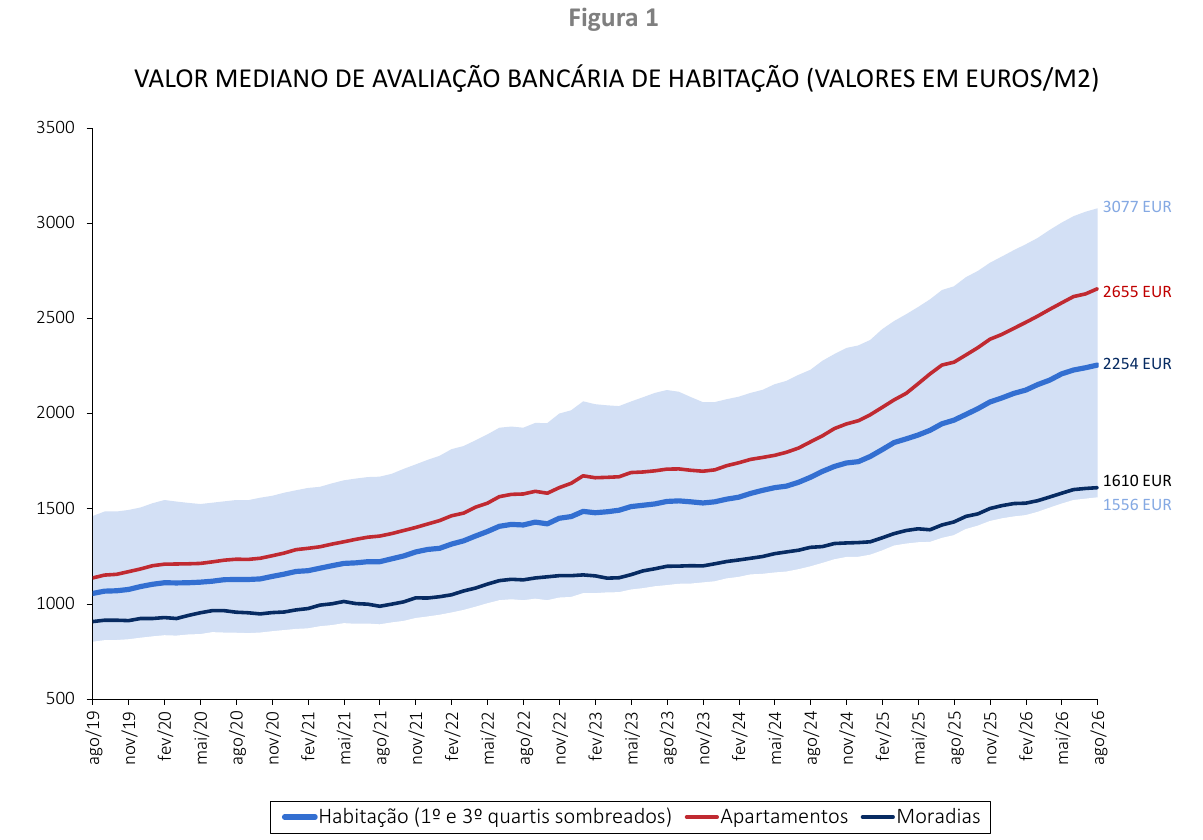 Figure 4: Bank valuations have risen without any significant break since 2019 and flats have pulled away from houses, which makes houses the entry point with the most room to gain value through renovation. Source: INE, Inquérito à Avaliação Bancária na Habitação, agosto de 2026 (Survey on Bank Valuation of Housing, August 2026), Figure 1, Sep 2026. Chart published by the source (in Portuguese), captured 7 Oct 2026.
How much is a square metre of housing worth in Portugal?
About €2,254/m². That was the median bank valuation (avaliação bancária) in August 2026, up 14.7% in a year, with flats at €2,655/m² and houses at €1,610/m², according to INE, Portugal’s national statistics office (INE, Sep 2026).
- In Q2 2026, prices of existing homes rose 18.0% year on year, above the 12.3% for new homes (INE, Sep 2026).
- Portugal’s house price index stood at 301.4 in Q2 2026, with 2015 = 100, against 168.6 in the EU: prices have tripled in just over ten years (Eurostat, Oct 2026).
- After inflation, real house prices have more than doubled since 2015, with the index at 228.3 in Q2 2026 (OECD, Oct 2026).
- In 2025, 71.2% of the population lived in an owner-occupied home, above the EU’s 68.5%, and 39.7% owned their home outright with no mortgage (Eurostat, Sep 2026).
Are homes in Portugal expensive compared with Europe and with incomes?
Yes, and more so than in any other EU country. In Q2 2026, prices rose 16.5% in a year, the largest increase of the 27, against 4.7% in the EU and 4.0% in the euro area (Eurostat, Oct 2026).
- European Commission staff estimate that at the end of 2024 Portuguese homes were overvalued by around 35%, the largest average overvaluation in the EU (European Commission, Oct 2025).
- In June 2025, real house prices were 21% above their long-term alignment with real national disposable income per household (IMF, Jun 2026).
- The standardised price-to-income ratio was 44.7% above its long-term average in Q2 2026 (OECD, Oct 2026).
- Buying has become far more expensive than renting: the price-to-rent ratio has more than doubled since 2015, with the index at 211.2 in Q2 2026 (OECD, Oct 2026).
- In 2025, house prices rose 17.6%, three times faster than household disposable income (5.7%), according to Banco de Portugal, the central bank (Banco de Portugal, May 2026).
- Foreign buyers accounted for 28% of housing transactions in 2025, a share that has held steady between 23% and 31% since 2019 (Banco de Portugal, May 2026).
How much does a square metre cost in Porto, Braga and Aveiro?
In the Área Metropolitana do Porto (Porto metro area), the median bank valuation was €2,299/m² in August 2026, above the national figure, while Cávado (Braga sub-region) came in at €1,892/m² and Região de Aveiro (Aveiro region) at €1,722/m² (INE, Sep 2026).
- In actual sales in Q1 2026, the median price reached €3,729/m² in the municipality of Porto (+21.6% in a year) and €2,240/m² in Braga (+25.0%), both above the national increase (INE, Jul 2026).
Energy efficiency and comfort at home
Portugal has some of the mildest winters in Europe, yet it is among the countries where the most people are cold at home. The problem is not the climate, it is the buildings: walls, roofs and windows that let out what little heat families pay for.
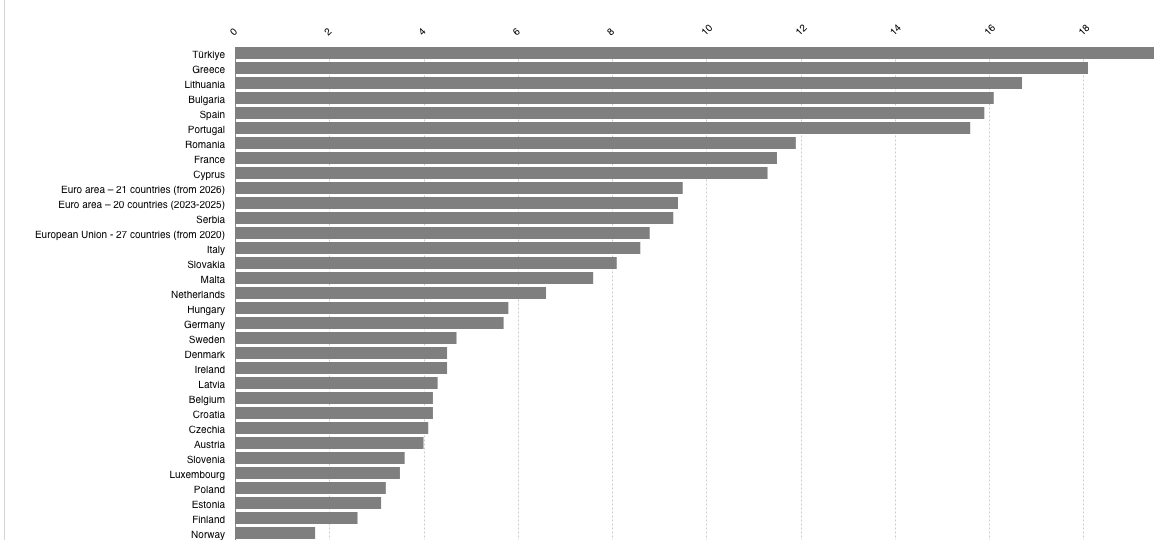 Figure 5: Portugal sits in Europe’s leading group for being unable to heat the home, alongside Greece, Lithuania, Bulgaria and Spain and well above the EU average. It is the clearest evidence that the shortfall lies in insulation, not the thermometer. Source: Eurostat, Inability to keep home adequately warm (ilc_mdes01), Sep 2026. Screenshot of the source page, captured 7 Oct 2026.
How much energy do Portuguese homes use and what energy rating do they have?
Homes account for almost a fifth of the country’s final energy use, and most existing homes that come onto the market are rated D or worse. The energy certificate (certificado energético) figures are our calculation from the open data of the Energy Certification System (Sistema de Certificação Energética, SCE), which covers homes sold, let or renovated, not the whole housing stock.
- The residential sector accounted for 18.2% of final energy consumption in Portugal in 2025, according to DGEG, Portugal’s directorate-general for energy and geology (DGEG, Jun 2026).
- Household energy consumption grew faster than any other sector in 2025, up 5.7% on 2024 (DGEG, Jun 2026).
- 53.2% of the 37,566 energy certificates issued for existing homes between July and September 2026 were rated D, E or F, according to ADENE, Portugal’s energy agency (ADENE, Oct 2026).
- Only 4.4% of those existing homes were rated A or A+ (ADENE, Oct 2026).
- After the works the picture flips: 57.6% of the 1,698 certificates for completed renovated homes in the same quarter were rated A or A+, and none came in below C (ADENE, Oct 2026).
How many households in Portugal cannot keep their home warm?
Around one in six people in Portugal lives in a home they cannot keep adequately warm, almost double the European average. Families do not run up debts to heat their homes: they simply heat them less.
- 15.6% of the population in Portugal could not keep their home adequately warm in 2025, against 8.8% in the EU-27 (Eurostat, Sep 2026).
- Portugal has the 5th highest rate among the 27 Member States, behind only Greece, Lithuania, Bulgaria and Spain (Eurostat, Sep 2026).
- Among people below the at-risk-of-poverty threshold, the share rises to 30.6% (Eurostat, Sep 2026).
- Only 3.6% of the population were in arrears on utility bills (electricity, gas, water, heating) in 2025, close to half the EU average of 7.0% (Eurostat, Sep 2026).
- Space heating accounted for just 28.8% of the energy used in Portuguese homes in 2024, the second lowest share in the EU, where the average is 61.5% (Eurostat, Jun 2026).
- The electric heater is the most common appliance used for space heating in Portuguese homes (64.8%), according to INE, Portugal’s national statistics office (INE, Nov 2021).
- Average electricity spending reached €751 per dwelling per year in 2020, against €523 in 2010 (INE, Nov 2021).
How energy efficient are homes in Porto, Braga and Aveiro?
The northern coast is no exception to the national pattern, and the Aveiro district is clearly worse than average. The figures are the share of certificates for existing homes rated D, E or F in Q3 2026, by district, based on our calculation from the SCE open data.
- In the Porto district, 49.9% of the 5,398 certificates issued for existing homes were rated D, E or F (ADENE, Oct 2026).
- In the Braga district the share was 54.1% (1,986 certificates) and in the Aveiro district 62.5% (2,037 certificates), both above the national average (ADENE, Oct 2026).
The most direct way to raise the energy rating of an older home is to insulate the envelope and replace the windows. See completed renovations or book a site visit.
Financing and grants for building work
Borrowing became more expensive again in 2026, but Portugal still pays less interest on home loans than almost the whole of the euro area. For anyone renovating, the biggest saving is not in grants, which depend on calls with limited budgets: it is in the 6% VAT (IVA) on renovation contracts, which needs no application and has no budget cap.
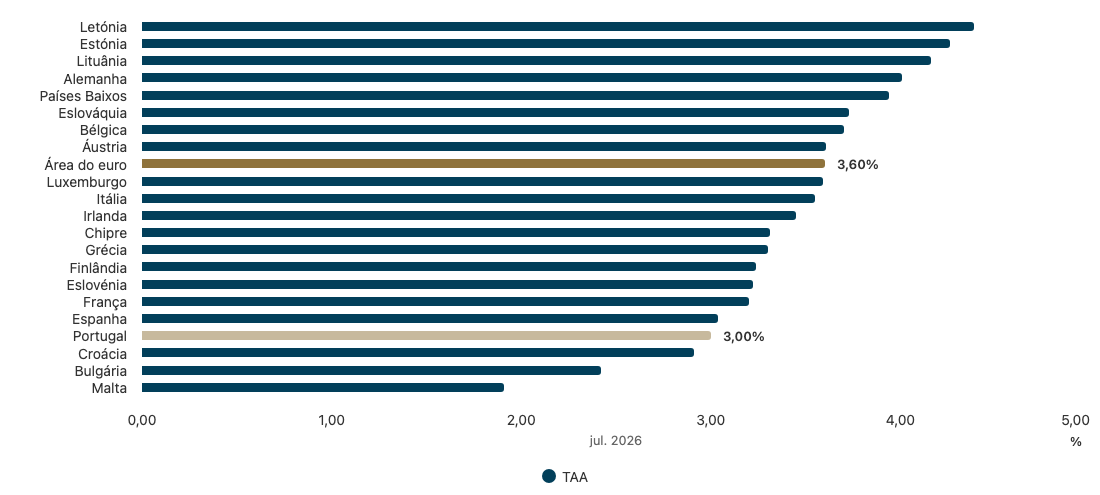 Figure 6: Portugal has one of the lowest interest rates in the euro area on new housing loans, below Spain, France and Germany, which makes financing building work cheaper than in most European partners. Source: Banco de Portugal, Taxas de juro e montantes de novos empréstimos e depósitos: nota de informação estatística de agosto de 2026 (Interest rates and amounts of new loans and deposits: statistical release, August 2026), Aug 2026. Chart published by the source (in Portuguese), captured 7 Oct 2026.
How much does a mortgage cost in Portugal today?
Interest rates rose again in August but remain close to 3%. Anyone who took out a loan recently pays a monthly instalment well above the average across all outstanding contracts.
- The implied interest rate across all housing loan contracts rose to 3.162% in August 2026, according to INE, Portugal’s national statistics office (INE, Aug 2026).
- For contracts signed in the previous three months, the average instalment rose to €744, up 14.3% on a year earlier (INE, Aug 2026).
- The average outstanding capital on housing loans reached €80,188 (INE, Aug 2026).
- The average interest rate on new housing loans was 3.00%, against 3.60% in the euro area, the fourth lowest rate among euro countries, according to Banco de Portugal, the central bank (Banco de Portugal, Aug 2026).
- New housing loan contracts totalled €2.129 billion in August, €229 million less than in July (Banco de Portugal, Aug 2026).
- 87% of new housing loans were taken out at a mixed rate, with a fixed rate for an initial period (Banco de Portugal, Aug 2026).
How much can a bank lend me for home renovation in Portugal?
Since 1 August 2026 the rules on monthly affordability are tighter, but a loan for works on your own permanent home can reach 90% of the property’s value after the works.
- Banco de Portugal recommends that loans for buying, building or carrying out works on a permanent own home should not exceed a loan-to-value (LTV) ratio of 90%, and 80% for other purposes (Banco de Portugal, Jul 2026).
- The debt-service-to-income (DSTI) limit fell from 50% to 45% of income for contracts assessed from 1 August 2026, with exceptions capped at 10% of the amount lent per half-year (Banco de Portugal, Jul 2026).
- Personal loans for the energy transition can run for up to 10 years, against 7 years for standard personal loans (Banco de Portugal, Jul 2026).
What VAT rate and public grants apply to home renovation in Portugal?
Home renovation contracts pay VAT at 6% (IVA), and anyone building their own home can recover part of the VAT paid at 23%. Fundo Ambiental (the Environmental Fund) grants exist, but they close quickly.
- Contracts for the renovation, repair or maintenance of homes pay VAT at 6%, and materials only qualify for the reduced rate if they do not exceed 20% of the value of the works, under the law published in the Diário da República, Portugal’s official gazette (Diário da República, Oct 2026).
- Anyone who commissions the construction of their own permanent home can claim back the difference between VAT at the standard rate and at 6%, for VAT due up to 31 December 2032, and the tax authority (AT) has 150 days to pay (Diário da República, May 2026).
- Refund claims for the first three quarters of 2026 can be submitted from 1 October 2026 (Diário da República, May 2026).
- The More Sustainable Buildings Support Programme 2023 (Programa de Apoio a Edifícios Mais Sustentáveis) opened with €30 million, used it up by 22 January 2025 and was topped up with €60 million (Fundo Ambiental, Feb 2025).
- Phase 2 of the E-Lar programme had €60,834,518 and closed to new applications on 24 March 2026 (Fundo Ambiental, Mar 2026).
- The energy efficiency in buildings component of the Recovery and Resilience Plan (PRR) has €622 million and typically funds 50% to 70% of project costs (Recuperar Portugal, Sep 2025).
On a home renovation, the VAT treatment depends on the share of materials in the invoice. At BluePeak we state the expected VAT treatment in every quote we issue.
The labour shortage
The shortage of tradespeople is no longer a cyclical complaint, it is structural: in little more than a decade, the share of builders held back by a lack of staff has more than quadrupled. For anyone planning building work, this means full diaries and fast-rising wages, so booking early is worth more than haggling late.
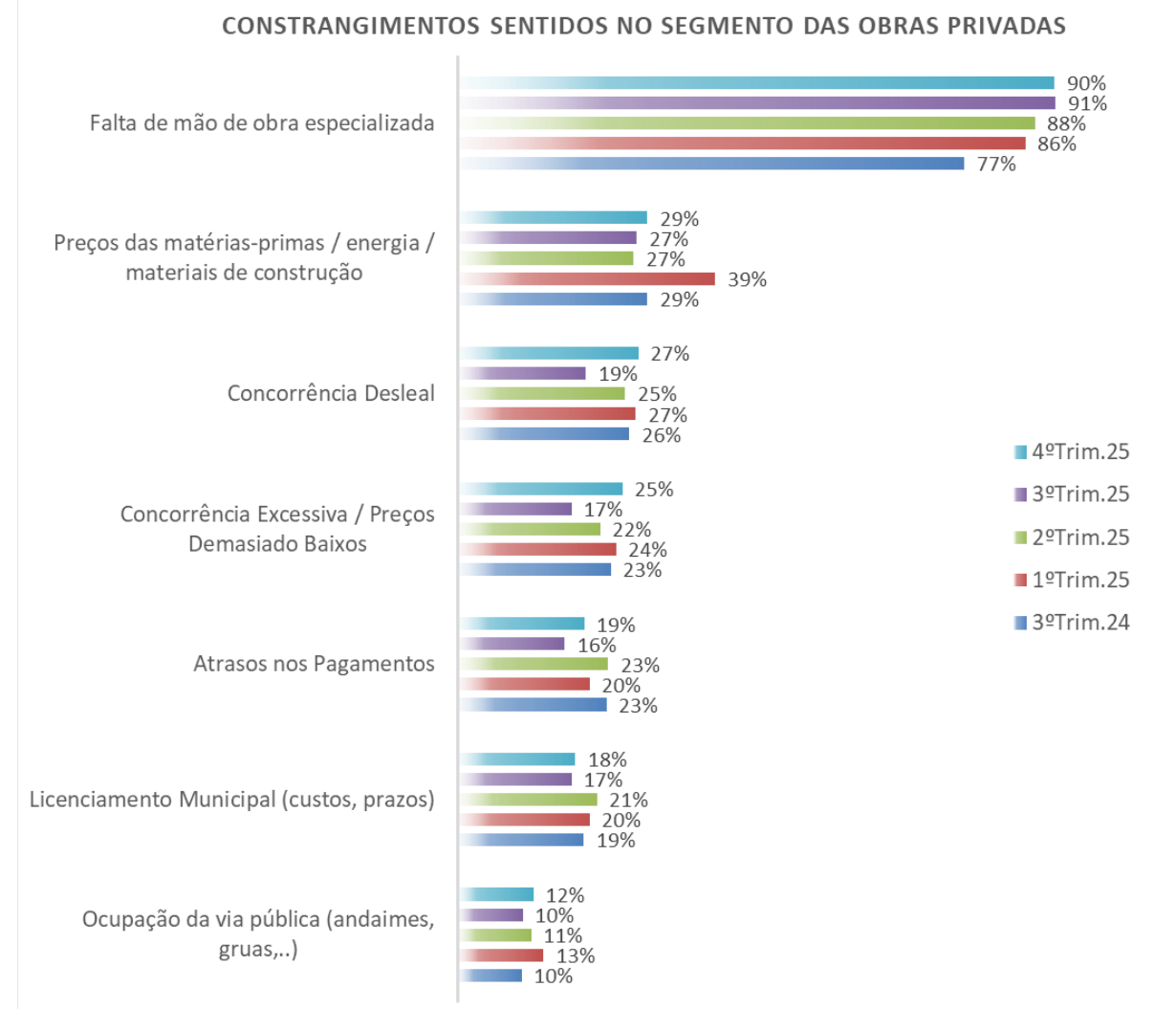 Figure 7: In private construction, the shortage of skilled labour is far ahead of any other obstacle, including material prices and municipal permits (licenciamento). Source: AICCOPN, Inquérito à Situação do Setor, 4.º Trimestre 2025 (Survey of the State of the Sector, Q4 2025), Jan 2026. Chart published by the source (in Portuguese), captured 7 Oct 2026.
How many construction firms in Portugal say they are short of workers?
It depends on how the question is asked, but every source points the same way. The European Commission’s harmonised survey shows that a lack of staff is now the main constraint cited by Portuguese builders, far above where it was a decade ago.
- In Q4 2025, the shortage of skilled labour was the main constraint for 90% of private construction firms surveyed by AICCOPN, the sector’s industry association (AICCOPN, Jan 2026).
- In September 2026, 25.8% of construction firms in Portugal named a shortage of labour as a factor limiting activity, against 29.1% on average in the EU (European Commission, Sep 2026).
- In the same survey, 67.6% of Portuguese builders reported no limiting factor at all, which makes the lack of staff the most cited obstacle among the rest (European Commission, Sep 2026).
- In September 2014, only 5.8% of Portuguese builders named a shortage of labour as a constraint (European Commission, Sep 2026).
- The recent peak was in September 2022, when 34.6% of Portuguese construction firms said they were constrained by a lack of workers (European Commission, Sep 2026).
How much do construction workers earn in Portugal and how fast are wages rising?
Construction wages are rising at close to 8% a year, and finishing trades are among those with the biggest increases. Employment in the sector is also growing, which signals demand, not a lack of work.
- The monthly wage rate for construction workers was €1,433.7 in April 2026, up 8.1% on a year earlier, according to DGCP/MTSSS, the labour ministry’s statistics office (DGCP/MTSSS, Apr 2026).
- Tilers saw pay rises of 9.0% in a year, and plumbers and building painters of 8.7% (DGCP/MTSSS, Apr 2026).
- The hourly wage rate in construction stood at €8.3, €0.6 more than in April 2025 (DGCP/MTSSS, Apr 2026).
- Construction employed 400,400 people in Q2 2026, up 5.8% on the previous quarter, according to INE, Portugal’s national statistics office (INE, Aug 2026).
- The balance of Portuguese builders’ employment expectations for the next three months was +8.3 points in September 2026, above the EU’s +5.1 (European Commission, Sep 2026).
How many licensed builders and construction workers are there in northern Portugal?
The Norte region has the largest share of the country’s licensed firms and construction workers. Even so, the vast majority of licences (alvarás) belong to small firms, which helps explain why diaries fill up so quickly.
- The Norte region holds 33.3% of valid contractor licences (alvarás) and 38.2% of valid contractor certificates in Portugal, according to IMPIC, the public procurement, property and construction regulator (IMPIC, Oct 2025).
- 80% of licences valid on 30 June 2025 were in classes 1 and 2, which cover lower-value works (IMPIC, Oct 2025).
- The number of licences grew by 7.1% and certificates by 5.7% in the year to 30 June 2025 (IMPIC, Oct 2025).
- The Norte region employs 43.0% of workers in the construction trades tracked on the mainland (DGCP/MTSSS, Apr 2026).
- In the Norte region, the average monthly wage rate for skilled construction workers was €1,301.0 in April 2026 (DGCP/MTSSS, Apr 2026).
The future: the EU directive and renovation targets
The rules that will shape building work over the next decade have already been written; Portugal just has to put them into law. The EU deadline passed in May and the country’s transposition is still only half done, but the national and EU targets already show the direction: less energy, more renewables and the worst-performing homes renovated first.
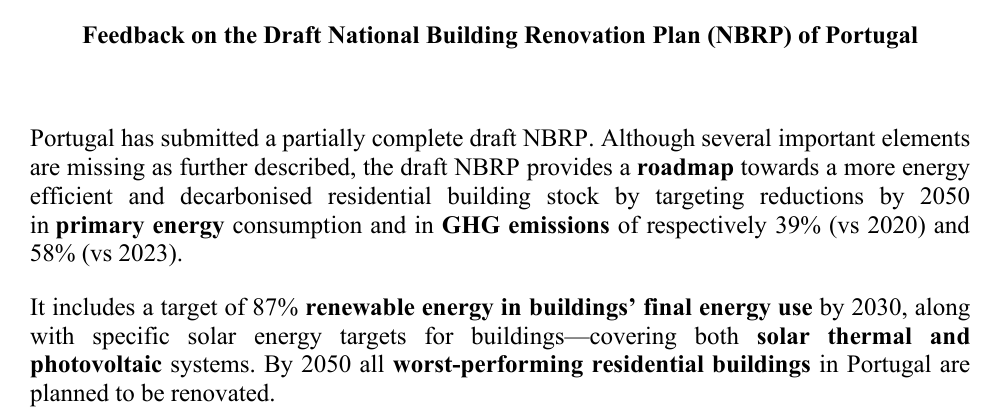 Figure 8: The European Commission rated Portugal’s first building renovation plan as partially complete, despite ambitious targets for energy, emissions and renewables. The final plan must reach Brussels by the end of 2026. Source: European Commission, Feedback on the Draft National Building Renovation Plan (NBRP) of Portugal, Jul 2026. Screenshot of the source document, captured 7 Oct 2026.
Has Portugal transposed the new EU buildings directive?
Not fully. As of 7 October 2026, the only law published in the Diário da República (Portugal’s official gazette) that transposes Directive (EU) 2024/1275 is partial and dates from February 2025. No issue of the 1st series published in 2026 up to that date mentions the directive.
- Member States had until 29 May 2026 to bring into force most of the rules of the revised Energy Performance of Buildings Directive (EUR-Lex, May 2024).
- Decree-Law no. 11/2025 (Decreto-Lei n.º 11/2025) only partially transposed the directive: it ended financial incentives for installing stand-alone fossil fuel boilers from 1 January 2025 (Diário da República, Feb 2025).
- In the EU database of national transposition measures, Portugal has 2 measures notified for this directive, both linked to the 1 January 2025 deadline (EUR-Lex, Oct 2026).
- On 15 July 2026, the Commission sent letters of formal notice to all 27 Member States, Portugal included, for failing to fully transpose the directive, giving them two months to reply (European Commission, Jul 2026).
- In March 2026, Portugal had already received a letter of formal notice (INFR(2026)2030) for failing to submit its draft National Building Renovation Plan by 31 December 2025 (European Commission, Mar 2026).
What changes for people building or renovating a home in Portugal?
New homes already have to be nearly zero-energy and, from 2030, they will have to be zero-emission. For the existing stock, the directive sets an average cut in energy use, with the largest share coming from the worst-performing homes.
- Since 1 July 2021, all new buildings in Portugal have had to be nearly zero-energy buildings (NZEB) (Diário da República, Dec 2020).
- All new buildings will have to be zero-emission buildings from 1 January 2030, and new public buildings from 1 January 2028 (EUR-Lex, May 2024).
- By 31 December 2029, new residential buildings will have to have suitable solar energy installations wherever technically, economically and functionally feasible (EUR-Lex, May 2024).
- Each country must cut the average primary energy use of residential buildings by 16% by 2030 and by 20% to 22% by 2035, with at least 55% of that cut coming from renovating the worst-performing buildings (European Commission, Sep 2026).
What are Portugal’s targets for renovating homes?
Renovate most of the housing stock by 2030 and all of it by 2050. These are official targets, not results achieved.
- The Long-Term Strategy for Building Renovation (Estratégia de Longo Prazo para a Renovação dos Edifícios, ELPRE) sets an indicative goal of renovating 363.7 million m² of buildings by 2030 and 748.0 million m² by 2050 (Diário da República, Feb 2021).
- The ELPRE estimates investment of €143.492 billion by 2050 (2020 prices), of which €110.078 billion is in residential buildings (Diário da República, Feb 2021).
- The National Energy and Climate Plan (PNEC 2030) targets 70% of residential buildings renovated by 2030 compared with 2018, with a 15% saving in primary energy, according to DGEG, Portugal’s directorate-general for energy and geology (DGEG, Oct 2024).
- The draft National Building Renovation Plan targets cuts of 39% in primary energy (compared with 2020) and 58% in emissions (compared with 2023) across the residential stock by 2050, and 87% renewables in buildings’ final energy consumption in 2030; the final plan is due by 31 December 2026 (European Commission, Jul 2026).
- The national strategy against energy poverty aims to cut the share of the population unable to keep their home adequately warm to 10% in 2030 and below 1% in 2050, from 17.5% in 2020 (Diário da República, Jan 2024).
Methodology and Sources
We use primary sources only: the body that produced or collected the data (INE, Eurostat, the European Commission, Banco de Portugal, ADENE, the OECD, the Diário da República official gazette, IMPIC, DGEG, IHRU, DGCP/MTSSS and AICCOPN’s own surveys). We do not cite aggregators, news articles or other statistics pages. Every number was checked on the original page or file on the date shown, and each citation date is the source’s publication or update date. Where a figure is our own calculation from public data (for example, energy-rating shares from the SCE open data), the text says so and links to the file used. Most sources publish in Portuguese; titles are translated in figure captions. The page is reviewed monthly, and provisional values are replaced when sources publish new data.
Glossary
- ADENE: Portugal’s energy agency, which runs the building energy certification system (SCE).
- AICCOPN: Portuguese association of civil construction and public works companies.
- Alvará: Licence issued by IMPIC that allows a company to carry out construction work in Portugal.
- Bank valuation: Value per m² assigned by bank surveyors to homes used as mortgage collateral.
- Cávado: NUTS III sub-region that includes Braga.
- Certificado energético: Energy performance certificate, required to sell or rent a home in Portugal.
- DGEG: Directorate-General for Energy and Geology.
- ELPRE: Portugal’s Long-Term Strategy for Building Renovation.
- EPBD: EU Energy Performance of Buildings Directive (Directive (EU) 2024/1275).
- ICCHN: INE’s monthly index of construction costs for new housing.
- IMPIC: Portuguese institute for public procurement, real estate and construction.
- INE: Instituto Nacional de Estatística, Portugal’s national statistics office.
- IVA: Portuguese VAT.
- NUTS: EU classification of statistical regions and sub-regions.
- PNEC 2030: Portugal’s National Energy and Climate Plan.
- PRR: Portugal’s Recovery and Resilience Plan (EU recovery funds).
- SCE: Portugal’s building energy certification system.
Sources
- Eurostat, document 1
- Eurostat, document 2
- Eurostat, document 3
- Eurostat, document 4
- Eurostat, document 5
- Eurostat, document 6
- Eurostat, document 7
- Eurostat, document 8
- Eurostat, document 9
- Eurostat, document 10
- Eurostat, document 11
- Eurostat, document 12
- Eurostat, document 13
- Eurostat, document 14
- Eurostat, document 15
- Eurostat, document 16
- Eurostat, document 17
- Eurostat, document 18
- Eurostat, document 19
- Eurostat, document 20
- INE, document 1
- INE, document 2
- INE, document 3
- INE, document 4
- INE, document 5
- INE, document 6
- INE, document 7
- INE, document 8
- INE, document 9
- INE, document 10
- INE, document 11
- INE, document 12
- INE, document 13
- INE, document 14
- European Commission, document 1
- European Commission, document 2
- European Commission, document 3
- European Commission, document 4
- European Commission, document 5
- European Commission, document 6
- European Commission, document 7
- Diário da República, document 1
- Diário da República, document 2
- Diário da República, document 3
- Diário da República, document 4
- Diário da República, document 5
- Diário da República, document 6
- OECD, document 1
- OECD, document 2
- OECD, document 3
- OECD, document 4
- AICCOPN, document 1
- AICCOPN, document 2
- AICCOPN, document 3
- Banco de Portugal, document 1
- Banco de Portugal, document 2
- Banco de Portugal, document 3
- DGEG, document 1
- DGEG, document 2
- EUR-Lex, document 1
- EUR-Lex, document 2
- Fundo Ambiental, document 1
- Fundo Ambiental, document 2
- IMPIC, document 1
- IMPIC, document 2
- ADENE
- DGCP/MTSSS
- IHRU
- IMF
- Recuperar Portugal